For a Muslim traveler, planning mainland China should begin with specific requirements rather than a general question about whether the country is “Muslim-friendly.” A restaurant’s documented halal offerings, a mosque’s existence and permission to organize religious activities are different matters. Beijing’s government publishes examples of halal dining, while national rules regulate foreigners’ religious activities and official travel advice identifies additional risks in Xinjiang. None of those facts establishes that every proposed itinerary will meet your needs. [S1, S3, S4] (sara.gov.cn)
The practical approach is to check each overnight stop and each long travel day. Write down what you require, obtain answers from the actual venues or providers, and keep a fallback for anything not confirmed. The recommendations below are a planning method—not a religious ruling, legal opinion or guarantee of safety.
This guide covers mainland China. It does not extend mainland rules or advisory statements to Hong Kong or Macao.
Important planning decisions
- Documented halal dining exists, but documentation is not current certification of every meal. [S4] (english.beijing.gov.cn)
- A listed mosque is a research lead, not guaranteed worship access. [S5] (english.beijing.gov.cn)
- Organizing religious activities raises different questions from ordinary travel. [S1] (sara.gov.cn)
- Xinjiang requires a distinct, personal risk assessment. [S3] (gov.uk)
- Build the itinerary from confirmed arrangements and keep missing answers visible.
Compare the constraints that matter to your trip
Use this table as a verification worksheet. “Not confirmed” should remain visible in your plan rather than becoming an assumption.
| Planning task | What to verify | Evidence to request | Suggested response if unresolved |
|---|---|---|---|
| Choosing an overnight base | Meals meeting your requirements near the exact hotel | Named restaurant, current address and direct answers about preparation | Change the hotel or arrange a confirmed meal |
| Eating halal meat | Sourcing and preparation acceptable to you | Relevant certification or supplier information, where available | Do not treat “no pork” as complete verification |
| Attending Friday prayer | Whether foreign worshippers can attend on your date | Confirmation from mosque staff or the responsible local organization | Keep the visit provisional |
| Planning women’s prayer access | Available space, access arrangements and ablution facilities | Specific venue response | Choose another confirmed arrangement |
| Organizing group worship | Applicable permissions and venue procedures | Written guidance from the responsible organization or authority | Do not organize it based on a tour seller’s assurance alone |
| Taking a long train journey | An acceptable meal before, during and after the journey | Confirmed provider or your own acceptable food plan | Avoid depending on an unverified onboard meal |
| Traveling during Ramadan | Meal times, storage and arrangements around fasting | Hotel and restaurant confirmation | Adjust transfers or arrange meals beforehand |
| Including Xinjiang | Advisory implications for your circumstances | Your government’s advice and individualized guidance where needed | Reconsider the stop separately from the rest of China |
The collective-worship and Xinjiang rows reflect official rules and advisories. The remaining rows are editorial verification recommendations, not claims that a particular facility or service exists. [S1, S3] (sara.gov.cn)
1. Define what “halal arrangements” must mean for you
Before contacting a hotel or tour company, specify your requirements. Your checklist might include verified meat sourcing, no pork or lard, restrictions on cooking alcohol, separate preparation equipment, or a particular certification standard. Do not allow a seller’s phrase “Muslim-friendly” to substitute for your own definition.
Ask questions about the exact restaurant and meal, not only the tour package:
- Which restaurant and branch will provide the meal?
- What evidence supports its halal claim?
- Can staff explain the meat supply and preparation?
- Are the sauces, stocks, seasonings and cooking methods acceptable to you?
- What happens if the planned restaurant is closed?
- Can the operator change the venue without your approval?
Keep a written record of the answers. Where staff cannot establish something you consider essential, mark the meal unverified and choose another arrangement. This is a conservative planning recommendation, not a judgment about any restaurant’s religious compliance.
An official dining example—and its limits
Beijing’s municipal government describes Donglaishun as offering halal dishes and identifies its Beijing APM main branch at Rooms 542–547, fifth floor, 138 Wangfujing Street, Dongcheng District. The same page describes halal dishes at Yitiaolong and halal barbecue and hotpot at Liu’s Barbecue. This establishes that named halal offerings are documented by a public authority; it is stronger evidence than an anonymous recommendation. [S4] (english.beijing.gov.cn)
However, the page is dated September 27, 2024. It does not verify today’s opening hours, every branch’s preparation, a certification standard acceptable to you, or availability on your travel date. Use it to build a shortlist, then contact the precise branch before making it an essential part of your itinerary. [S4] (english.beijing.gov.cn)
2. Separate mosque sightseeing from dependable prayer access
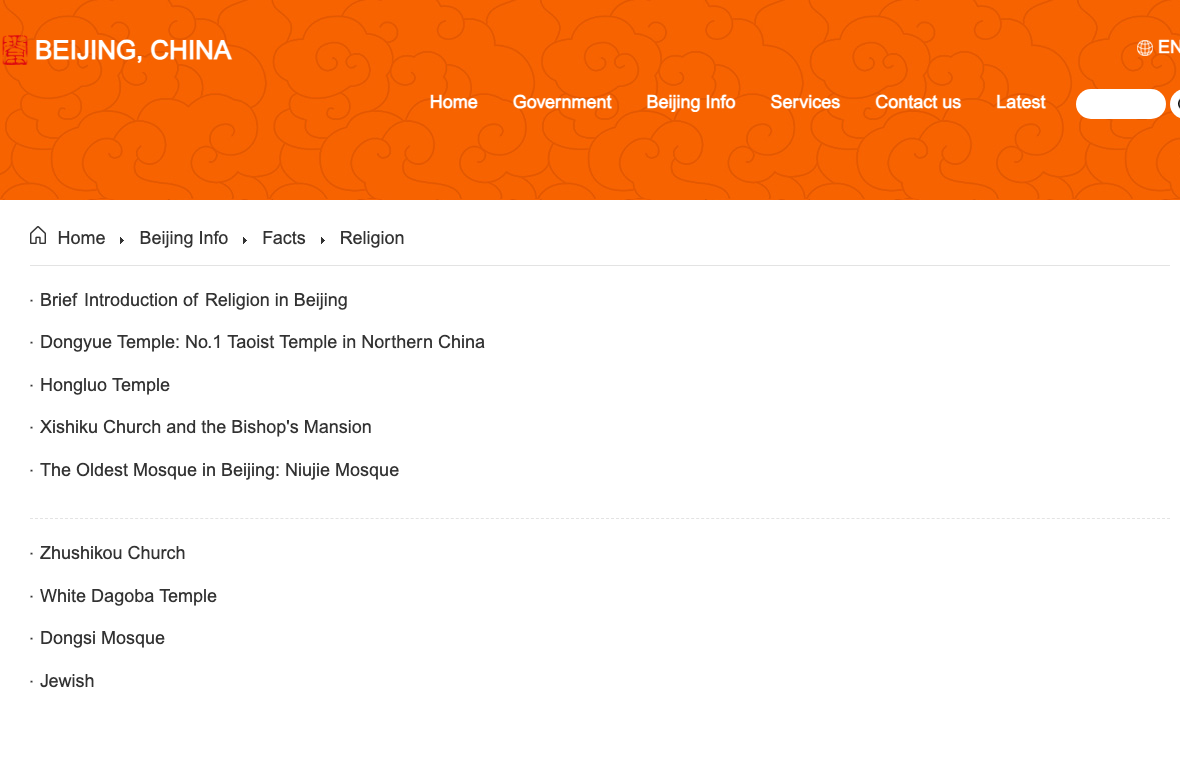
Beijing municipal information directory captured October 11, 2026. A listing is not proof of present worship access, opening hours or facilities. Government directory.
Beijing’s official religion directory lists Niujie and Dongsi mosques. That supports their inclusion as places to investigate, but a directory entry is not confirmation that a foreign traveler can attend a particular prayer, access every area or use the facilities they need. [S5] (english.beijing.gov.cn)
Contact the venue with concrete questions:
- Can foreign Muslim visitors attend worship on the intended date?
- What time should they arrive?
- Are identification or advance arrangements needed?
- Is a women’s prayer space available?
- What ablution facilities are accessible?
- Are there temporary closures or changes to access?
- What are the photography and visitor rules?
Do not build a tightly timed attraction itinerary around an unconfirmed prayer visit. Leave enough flexibility to follow the venue’s instructions and change plans.
The legal distinction is also important. China’s rules for foreigners’ religious activities took effect on May 1, 2025. They address collective activities at registered religious venues or approved temporary locations, with procedures for foreigners organizing such activities. Organizing a gathering is therefore not interchangeable with visiting a religious site. [S1] (sara.gov.cn)
The FCDO advises that foreigners may participate in religious activities complying with Chinese law at registered or approved locations, while events they wish to hold must follow the relevant procedures. Obtain local legal guidance for anything beyond an ordinary visit, particularly an organized religious program. This article does not determine how the rules apply to an individual’s private prayer. [S2] (gov.uk)
3. Treat Xinjiang as a separate risk decision
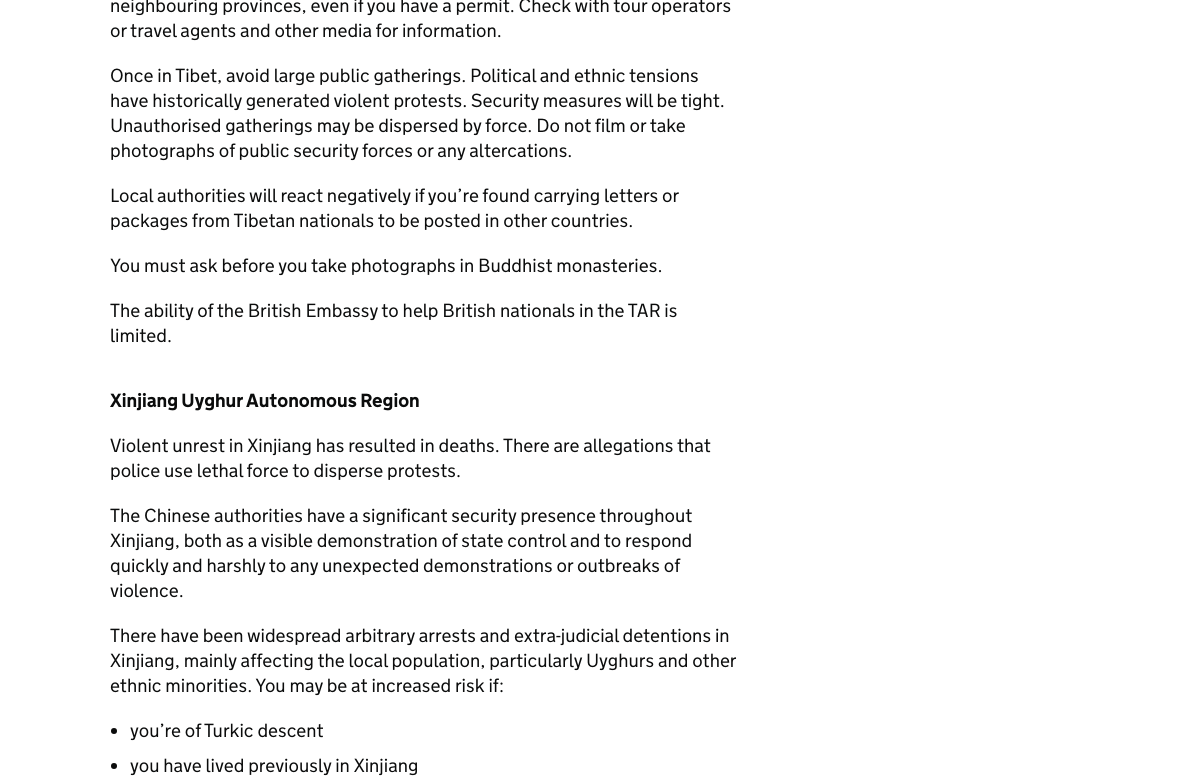
UK Foreign Office official regional travel advice captured October 11, 2026. This is the UK government’s assessment, and nationality-specific consular guidance may differ. Latest FCDO advice.
Do not choose Xinjiang solely because you expect food or Islamic heritage to make travel convenient. The FCDO’s regional advice explicitly identifies increased-risk circumstances including appearance or practices perceived as Muslim, public participation in Islamic religious practices, Turkic descent, previous residence in Xinjiang and foreign nationality. [S3] (gov.uk)
It also describes extensive security checks, treats mosques and other religious sites as sensitive, and warns that British consular assistance in the region is limited. These are substantive considerations—not minor inconveniences to bury beneath a food itinerary. [S3] (gov.uk)
If Xinjiang is proposed, assess that portion independently. Read the advice issued by your own government, consider your personal background and activities, and request additional guidance where necessary. For U.S. travelers, the retrieved State Department advisory dated September 4, 2026 places mainland China at Level 2 and highlights arbitrary enforcement of laws, exit bans and unjust detention risks. Check the live advisory again before departure. [S6] (travel.state.gov)
A positive account from another traveler cannot resolve the risk for someone with a different nationality, background or itinerary. Nor should a warning about Xinjiang be mechanically applied as an identical description of every Chinese city.
4. Choose hotels around verified daily arrangements
Instead of booking a hotel first and searching for meals afterward, compare accommodation against the arrangements you have confirmed.
Ask the hotel for the name and location of a suitable restaurant—not simply whether “halal food is nearby.” If the hotel offers to prepare meals, request the same sourcing and preparation information you would ask from an independent restaurant. Decide whether those answers meet your requirements before purchasing a non-refundable meal package.
For prayer planning, ask about any facility you intend to rely on. This research did not establish a nationwide hotel prayer-room standard, a universal qibla provision or a standard policy for ablution arrangements. Do not assume those features are included.
A useful hotel comparison includes:
- Distance to your confirmed meal options.
- Distance to a confirmed worship venue, if required.
- Whether late arrival leaves an acceptable meal available.
- Access to food storage when you need it.
- Flexibility to return between activities.
- Cancellation terms if essential arrangements fall through.
The right base is the one that meets your verified needs with manageable daily travel—not necessarily the neighborhood a general sightseeing guide ranks first.
5. Protect travel days and Ramadan meal times
Treat airport connections, train journeys and full-day excursions as separate food-planning tasks. Ask the airline or operator whether the specific service provides an acceptable meal, how to request it and what happens if it is unavailable. This handoff does not establish universal halal catering on Chinese airlines, trains or airport concessions.
Similarly, do not rely on an airport or station prayer room without confirming the exact terminal or station. No terminal-specific prayer facility was verified for this article.
If traveling during Ramadan, map transfers against your intended prayer and meal schedule. Confirm restaurant availability rather than assuming a Muslim-area business follows particular hours. Ask your hotel about storing food and arranging meals outside its normal service times. Seek qualified religious advice for personal questions about fasting while traveling.
Prepare essential information offline. The FCDO notes that mainland China restricts internet access and blocks services including Google. Save venue names, Chinese addresses, confirmation messages and contact details before departure instead of depending on live searches at a critical moment. [S2] (gov.uk)
6. Check religious materials and organized activities before departure
Packing personal belongings is different from bringing materials to distribute or running a religious program. China’s rules regulate religious materials and prohibit activities including unauthorized preaching, collective religious activities and distributing religious publicity materials. Do not infer that a tourist booking authorizes those activities. [S1] (sara.gov.cn)
If you plan to bring multiple religious publications, supply materials to others, teach, speak publicly or organize worship, seek qualified advice beforehand. This guide deliberately does not turn the law’s quantity provisions into a universal packing allowance: item classification, purpose and applicable procedures require careful interpretation.
Step-by-step pre-booking checklist
- Write your non-negotiables. State food, certification, prayer, women’s facilities and fasting requirements.
- List every overnight stop and long travel day. Include arrival nights and excursion days.
- Find specific providers. Record restaurant branches, hotel contacts and intended worship venues.
- Request direct confirmation. Ask questions that produce usable answers, not generic reassurance.
- Review regional risks separately. Give Xinjiang its own decision.
- Resolve entry eligibility elsewhere. Check your passport and complete route through official immigration channels; this article supplies no visa exemption promise.
- Create a fallback. Decide what you will do when a meal or facility cannot be verified.
- Book around the confirmed essentials. Preserve flexibility where answers remain outstanding.
- Reconfirm before travel. A previously documented venue or arrangement may not be available on your dates.
FAQ
Is China suitable for a Muslim holiday?
That depends on your itinerary and requirements. Official sources document halal dining examples, but they also establish religious-activity restrictions and regional warnings. Verify the practical arrangements and assess risks rather than accepting a nationwide yes-or-no assurance. [S1, S3, S4] (sara.gov.cn)
Can I assume a vegetable meal meets my requirements?
No. As a planning method, verify the ingredients and preparation you require instead of relying on the dish’s name. This article does not certify vegetarian food as halal or decide which alternatives are religiously acceptable to you.
Can I attend Friday prayer at a famous mosque?
Do not assume it from a tourism listing. Contact the specific mosque about your date, foreign-worshipper access and facilities. The official directory checked here does not establish those details. [S5] (english.beijing.gov.cn)
Is wearing a headscarf guaranteed to cause no difficulties?
This research supports no such nationwide guarantee. In particular, the FCDO’s Xinjiang warning explicitly mentions appearance or practices perceived as Muslim. That is a regional risk statement, not evidence of a uniform mainland dress ban. [S3] (gov.uk)
Do I need a Muslim tour operator?
This research found no general requirement to book through one. If you choose an operator, evaluate its actual meal, worship-access and fallback arrangements. Branding is not evidence that every promise has been verified.
Related CTD tools and next steps
- If you already have a route, Muslim China Itinerary Review is the separate optional personalized service; this free guide covers advance self-checks.
- Choose a suitable first hotel using Where to Stay in Beijing after confirming food and transport needs.
- Use China map app comparison to save provider-confirmed locations before departure.
- Check whether your passport needs a visa for China for a separate entry decision.
Official references and editorial limitations
Checked October 11, 2026. This is a practical planning framework, not individual religious or legal advice. Rules for collective religious activities depend on national law and local procedures, and legal translations should be reviewed by a qualified bilingual adviser before you rely on them. Descriptions of mosques or restaurants are not claims of current opening hours, dietary certification or access. UK FCDO risk statements reflect the UK government's published assessment, not a prediction about any particular traveler.