China Travel Decisions · Cruise Visa-Free
China 15-Day Cruise Visa-Free Entry: Group, Port & Same-Ship Rules
This is not a blanket “cruise passengers get 15 visa-free days” rule. The policy depends on an organized foreign tourist group, a Chinese travel agency, designated cruise ports, permitted areas and departure by the same cruise ship as scheduled.
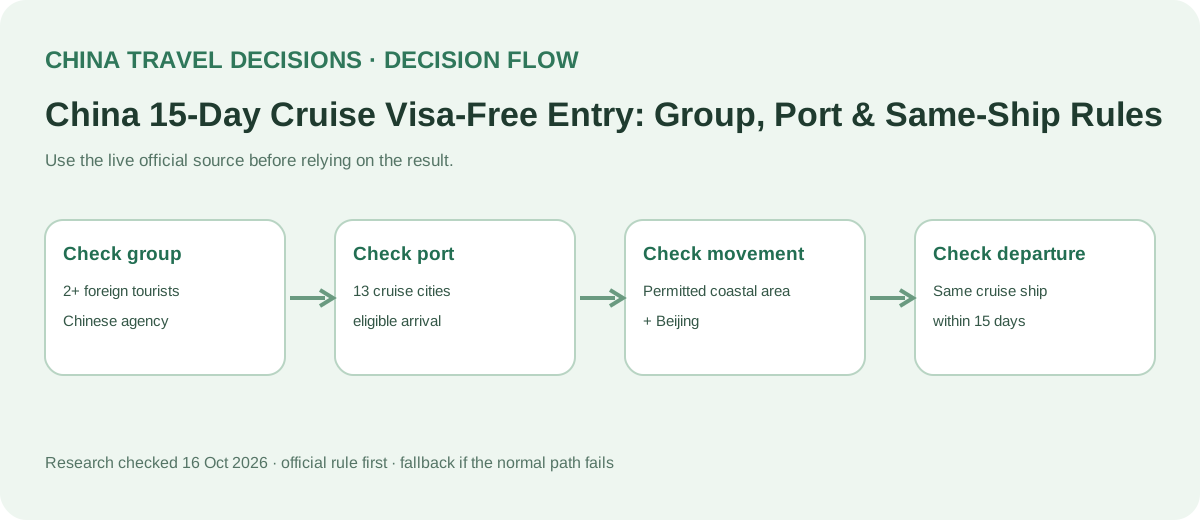
Quick answer: China’s special 15-day cruise visa-free policy applies to qualifying foreign tourist groups arriving by cruise ship, not to every individual cruise passenger. NIA’s current rule requires a group of two or more, organized and handled by a Chinese travel agency, entry through an eligible cruise port in one of 13 named cities, travel within the permitted coastal areas/Beijing, and departure from China by the same cruise ship as scheduled within 15 days.
Does your cruise fit the special 15-day policy?
Choose the closest situation
Confirm the travel agency is actually handling the visa-free tourist group, the arrival cruise port is eligible, the planned shore itinerary stays inside the permitted area, and the group departs China by the same cruise ship as scheduled within 15 days.
Do not assume the special cruise-group policy applies.The official rule is for foreign tourist groups of two or more organized/handled by a Chinese travel agency. Check whether you qualify under another visa-free policy or need a visa.
This specific policy is not designed for cruise-in / flight-out travel.NIA states that the group should continue to the next scheduled port and depart China by the same cruise ship as scheduled. Use another visa/visa-free basis if you intend to fly out.
Check the permitted-area boundary.The cruise-group policy covers specified coastal provincial-level areas and Beijing. It is not a 15-day nationwide travel permit.
Do not rely on this special policy.The arrival must use an eligible cruise port in the official 13-city list. Check another lawful entry basis for the actual port.
The five conditions to verify before booking
| Condition | What the official policy requires | Your proof |
|---|---|---|
| Group | Two or more foreign tourists | Passenger/group list |
| Agency | Organized and handled by a Chinese travel agency | Written confirmation from the receiving agency |
| Arrival | Eligible cruise port in one of 13 named cities | Ship itinerary / port schedule |
| Movement | Within the permitted coastal areas and Beijing | Shore itinerary |
| Departure | Depart China by the same cruise ship as scheduled, within 15 days | Continuation/departure cruise itinerary |
Port and movement logic
NIA’s national notice lists cruise ports in 13 cities and permits group movement in the specified coastal provincial-level regions and Beijing. That makes this policy broader than a single Shanghai shore excursion but narrower than free travel throughout mainland China.
- Confirm the exact cruise terminal/port.
- Ask the Chinese receiving agency which visa-free policy it is using for the group.
- Check every overnight city/shore excursion against the permitted area.
- Keep the agency contact and group documentation available at entry.
Why “same cruise ship” changes the itinerary
The special policy is built around cruise-group entry, scheduled shore travel and continuation/departure by the same cruise ship. If you want to disembark permanently, travel inland independently, or fly home from China, check a different visa/waiver route before travel.
Ask your cruise operator / Chinese agency
请确认我们是否按“外国旅游团乘坐邮轮入境15日免签”政策办理。我们一共【人数】人,从【港口】入境,计划去【城市】,并按原计划乘同一艘邮轮从【港口】离境。请确认这些城市和行程都在允许范围内。
Please confirm that our group is being handled under the 15-day cruise tourist-group visa-free policy. We have [number] travelers, enter at [port], plan to visit [cities], and depart China on the same cruise ship from [port]. Please confirm the full itinerary is within the permitted area.
If one condition fails
- Do not ask the agency to “just use the cruise waiver anyway.”
- Check whether your nationality qualifies for the current 30-day unilateral waiver.
- Check whether a 240-hour transit route genuinely fits the entry/exit itinerary.
- If neither applies, obtain the appropriate visa before travel.
Frequently asked questions
Can a solo cruise passenger use this 15-day policy?
Not under the group condition stated in the official policy.
Can I fly home after entering on this cruise policy?
The specific policy requires departure by the same cruise ship as scheduled. Use another entry basis if you need a flight departure.
Can I visit Xi’an or Chengdu under this policy?
Do not assume so. The movement area is the official coastal/Beijing scope, not all of China.
Official sources
Rules, prices, operating routes and platform support can change. CTD is an independent travel resource. Recheck the linked official channel before paying or relying on a reservation.