Quick answer: A China itinerary is probably too rushed when it treats arrival days, rail transfer days and hotel changes as full sightseeing days. Before you pay for nonrefundable bookings, count how many usable hours remain after check-out, transport to the station, security, rail or flight travel, arrival transfer, hotel check-in and a realistic buffer. China Railway explicitly warns that train ticket checks stop before departure and that passengers must allow time for security and ID verification. There is no universal station-arrival time that works for every train. Official 12306 passenger guidance.
The simplest test is not “How many cities fit into seven days?” It is “How many real sightseeing blocks survive after unavoidable transfers and fixed entry windows?” Use the worksheet and two example routes below, then check your full itinerary with CTD only if you want an optional personal second opinion.
Four signals that a China trip is overpacked
| Signal | What to check | Practical correction |
|---|---|---|
| A different hotel almost every night | How many times will you pack, check out, commute and wait for a new room? | Keep one base longer or cut a one-night stop |
| A train ride labeled “only two hours” | Are station transfers, security, ID inspection and hotel arrival included? | Rebuild the door-to-door day, not just the ticket time |
| Big sights on an international arrival day | What happens if immigration, baggage, data setup or transport takes longer? | Protect arrival day for check-in and one flexible activity |
| Two fixed-ticket attractions across town | Can you reach both during their actual admission windows? | Put the less important stop on a separate day or remove it |
These are editorial planning signals, not Chinese government transport regulations. Your group’s physical stamina, mobility, family needs, holidays, booking flexibility and chosen route may make a slower plan worthwhile.
Step 1: Count usable days, not booked nights
A seven-night holiday does not automatically provide seven full sightseeing days. If you fly in on Sunday evening and leave the next Sunday morning, your first and last dates are often limited. Every major city-to-city move can consume another meaningful portion of a day.
Take your proposed calendar and label each day:
- Arrival: international flight, airport exit, immigration, baggage, payment/data check, transfer to your first bed.
- Full base day: no major hotel move; suitable for fixed entry and more ambitious sightseeing.
- Transfer: checking out, station/airport access, security, journey, local onward travel, another hotel check-in.
- Departure: keep space for transport to the airport, airport formalities and delays.
- Flexible/rest: optional sights, bad-weather adjustment or recovery after a demanding day.
The point is not to force one category on the whole day. It is to prevent a half-day arrival or transfer from being counted as both a travel day and a full sightseeing day.
Step 2: Calculate the door-to-door time of every intercity move
Write down each component before booking a same-day attraction in your destination city:
| Component | Source of your estimate | Often overlooked |
|---|---|---|
| Hotel room → station or airport | Exact addresses and live mapping around your date/time | You may be going to a different station than expected |
| Security, boarding and ID checks | Station/airline instructions and holiday crowd conditions | Passport checking and queues can take time |
| Train or flight time | Actual bookable itinerary, not a generic article | Schedule, terminal and station vary |
| Arrival terminal/platform → hotel | Metro/taxi route and baggage time | A city name is not a city-center arrival |
| Check-in, lunch or recovery | Your own real needs | Early room access or luggage storage is not guaranteed |
| Safety margin | Your preferred risk tolerance | No particular buffer is official or universal |
China Railway’s English FAQ says: ticket sales and boarding checks stop before departure; walking between station entrance, ticket counter, gates and platforms takes time; there may be queues at security, ID checking and baggage handling. It directs passengers to station-specific announcements for deadlines. Railway 12306 FAQ.
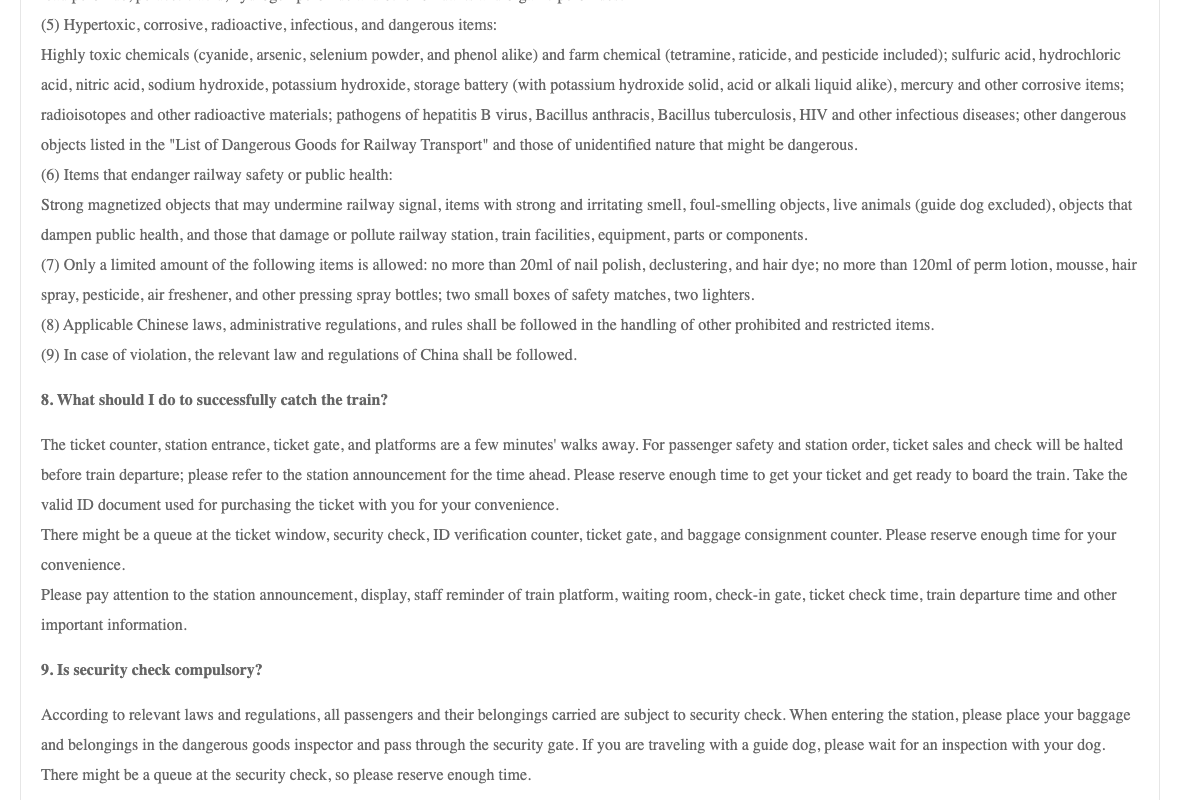
Unaltered public Railway 12306 guidance. This is a railway information page, not a ticket booking or live train schedule. Open 12306 official FAQ.
A worked example: why a short train ride can eliminate your morning
Assume illustrative, not real timetable, departure from hotel at 08:00 and the following personal estimates:
| Stage | Example elapsed time |
|---|---|
| Hotel to rail station | 45 minutes |
| Find entrance, security, passport and gate buffer | 50 minutes |
| Train ride | 2 hours 15 minutes |
| Arrival station to next hotel | 55 minutes |
| Food, luggage and hotel check-in | 45 minutes |
| Total before you settle | 5 hours 30 minutes |
The rail segment is 2 hours 15 minutes, but the day requires 5 hours 30 minutes before adding any sightseeing. These are intentionally hypothetical durations showing how to calculate; do not use them to time a real train. Replace every figure with your own route.
Step 3: Protect timed admissions, not just famous sights
Two attractions can be close on a map but incompatible with their real entry conditions. For a museum, landmark or protected historical site, check the official booking window, closed days, admission time and passport requirements. At the Great Wall, add the journey beyond central Beijing and any shuttle/cable-car/walking time.
For example, the Beijing government tourism directory lists different seasonally operating hours for sections of the Great Wall, and the municipal Mutianyu attraction page locates the site in Huairou District, outside central Beijing. Therefore, “Forbidden City plus Mutianyu plus cross-city train” is a potential scheduling conflict, not a generic one-day sightseeing plan.
If your must-see attraction has a fixed reservation, plan the transfer around the attraction, not the reverse. Confirm holiday exceptions and specific tickets with the venue before you commit.
If your route includes Dunhuang, protect the Mogao Caves reservation before scheduling a train or hotel change. Foreign-passport visitors need to distinguish regular from emergency tickets and use the correct official booking route; see Mogao Caves tickets with a foreign passport. A ticket inquiry or attempted payment is not a confirmed entry reservation.
Step 4: Use the 2-block method for a full sightseeing day
Rather than list five attractions with no travel time, give each full base day two main blocks plus optional free time:
- Morning block: one substantial district or reserved attraction.
- Afternoon block: one geographically compatible activity or a flexible neighborhood.
- Evening: only if travel, energy and opening hours allow it.
This is an editorial pacing heuristic, not an official tourism standard. A compact museum district may fit more stops; an out-of-town Great Wall trip may require nearly the whole usable day. Families with children, travelers with mobility requirements and those recovering from long-haul travel may need a single substantial block.
The practical rule is not to penalize yourself for dropping an attraction. A genuinely useful plan creates memorable visits, not an unrealistic checklist.
Step 5: Audit your first and last hotel nights
The first night should optimize the journey from your arrival airport and the reliability of getting into a room. The last night should protect your flight departure, especially when your plane leaves early.
Shanghai is a concrete example of why the airport’s name matters. Its government says Pudong is about 30 km from central Shanghai, while Hongqiao is about 13 km away; the airports have different metro, taxi and terminal arrangements. A transfer between them is also a separate itinerary segment, even with the Airport Link Line. These figures are official geographic/transport context, not promises of taxi time or cost on your travel date. Shanghai Airport Authority transport guide.
Official Shanghai municipal airport arrivals-service webpage, originally published March 19, 2026. This is a public city-source screenshot and not a live airport routing or train schedule. Source.
For a late international arrival, “airport → central landmark → hotel” often adds unneeded friction. “Airport → known hotel → flexible dinner” is the more robust default. For a morning departure, avoid sleeping in an entirely different city and expecting a tight same-day connection to work without contingency.
Example A: a seven-day route that is probably overloaded
Imagine a first-time traveler with seven calendar days, entering Beijing and leaving Shanghai:
| Day | Overloaded version | Why it creates friction |
|---|---|---|
| 1 | Land Beijing, cross town, visit three sights | Arrival time and immigration are not fully controllable |
| 2 | Great Wall and several central Beijing museums | Wall transfer and timed museum entry may compete |
| 3 | Rail to another city, check in, visit two paid attractions | Most of the day may be spent moving |
| 4 | Another rail journey and hotel change | Two consecutive transfer days reduce meaningful visits |
| 5 | Rail to Shanghai, cross-city shopping and night sightseeing | Requires another new hotel and city setup |
| 6 | Shanghai highlights plus a regional day trip | Multiple unrelated travel legs and little recovery time |
| 7 | Museum, packed shopping, airport departure | Hard deadlines can invalidate the day |
This is a hypothetical planning scenario, not a real rail timetable. The problem is the sequence of three consecutive hotel/rail moves combined with fixed sights, not that any city is intrinsically undesirable.
Example B: a more robust seven-day route
Keep the same two principal cities but reduce changes of base:
| Day | Revised plan | What becomes safer |
|---|---|---|
| 1 | Arrive Beijing, check in, flexible meal | No timed attraction tied to arrival delays |
| 2 | Beijing history district and one reserved landmark | Enough time for museum-specific entry checks |
| 3 | Great Wall day trip | No cross-country transfer that evening |
| 4 | Train to Shanghai, check into one hotel, optional walk | Makes the rail journey a real transfer day |
| 5 | Shanghai central-city highlights | Full base day |
| 6 | Shanghai neighborhood exploration or one day trip | Flexible choice based on energy and weather |
| 7 | Airport departure | Protect the fixed flight |
This sample does not assert that a specific train leaves at a particular time. You must verify the actual 12306 station and schedule, lodging, tickets and visa/entry requirements. The trade-off is clear: giving up two intermediate cities can restore several usable sightseeing blocks.
For trip lengths, see How Many Days in Beijing and How Many Days in Shanghai. For the first-city decision, use Beijing or Shanghai First?.
The 10-minute itinerary reality-check worksheet
Use this on each calendar day before booking:
| Question | Your answer |
|---|---|
| Do I sleep in the same hotel as the previous night? | Yes / No |
| What are my actual arrival and departure places, not only city names? | Addresses / stations / terminals |
| Is this an arrival, departure, transfer or full base day? | Category |
| What is the door-to-door transport budget including access, ID/security, journey and arrival? | My estimate |
| Which tickets have fixed entry times or closed-day restrictions? | Venue and window |
| What is the one must-keep experience today? | Priority |
| What could be removed without breaking the trip? | Optional activity |
| What is my plan if a train, payment account or route is delayed? | Fallback |
If several days require both a major transfer and two timed visits, revisit your assumptions. If a single missed train could ruin a nonrefundable attraction and the next morning’s journey, your route lacks resilience.
Typical repair order
- Remove one hotel change before optimizing tiny sightseeing intervals.
- Keep the same geographic region for several consecutive days.
- Put important timed-entry sights on a full base day.
- Move low-priority activities into flexible blocks.
- Prefer a route ending near the departure airport.
- Only after the itinerary works, compare exact tickets and prices.
The fastest repair is often dropping one overnight stop, not adding a second transport app or a more aggressive schedule.
Train booking and ticket uncertainty can change the plan
China Railway’s official website is the reference for real ticket availability. Do not assume a journey exists at an old advertised time. Separate requesting a reservation from actually obtaining a paid confirmed ticket.
There is an additional 2026 detail: a Beijing government update dated September 28, 2026 describes an advance reservation-request pilot for selected Beijing–Shanghai rail services, whose lead window has been adjusted toward 17–30 days. This does not mean every Chinese train ticket can be purchased 30 days ahead, and an unfulfilled request is not a confirmed seat. Official 2026 Beijing railway update. Check your specific route directly in 12306.
For issues after booking, see Train Ticket Has No Seat Number and 12306 Passport Verification Failed.
FAQ
How many cities should I visit in China in 7 days?
There is no valid universal number. Two cities with an easy connection can be more workable than a three-city loop with hard travel deadlines. Count hotel changes and door-to-door transfer time, then preserve real base days.
Can I visit the Great Wall and Forbidden City on the same day?
A particular schedule may allow it, but they are not two adjacent central-city stops. Great Wall sections are outside central Beijing, and official attraction booking/opening rules may restrict same-day plans. Verify real transport and entry before reserving both.
Is a two-hour high-speed train only a two-hour travel day?
No. Add transport to the departure station, security/ID checks, station walking, pre-departure boarding closure, arrival transport and hotel logistics. 12306 explicitly advises allowing for these components.
Is one night in each Chinese city a good idea?
Usually it creates repeated packing, check-in and transfer work. If a one-night stop is essential for an event or a route, it can still make sense, but do not count that date as a full day of sightseeing.
What if I have booked nonrefundable trains and hotels already?
Build an accurate timetable using the tickets you actually hold. First remove optional activities and identify any conflicting fixed-entry reservations. Check the operator’s genuine change/refund terms before trying to alter transport.
Can I get a personalized check for my exact China route?
Yes. CTD’s China Itinerary Review is a separate optional human service. This free page supplies the worksheet so you can diagnose and simplify a route yourself first.
Sources, competing coverage and editorial scope
Evidence reviewed October 11, 2026. CTD’s classified Opportunity Radar recorded 15 recent 7-day and 36 30-day observations for the “china itinerary too rushed” user problem, across 14 active days in 30 days. The ledger does not store the original individual posts or URLs, so those counts indicate classified demand rather than verified quotes, unique users, monthly Google search volume or payment willingness.
A comparable article already exists at Homeground China: “Is Your China Itinerary Too Rushed?” (published July 2026). This article’s difference is a door-to-door time worksheet, hypothetical total-time calculation, two seven-day scenarios and passport-specific railway boarding official citations; avoid copying their phrasing or claiming unique market coverage.
- China Railway 12306 English passenger boarding and ID guidance
- China Railway 12306 official timetable and booking
- Beijing government: September 2026 train reservation pilot update
- Beijing government: Mutianyu Great Wall location and transportation
- Shanghai Airport Authority city and inter-airport transport guide