Quick answer: If you are a foreign visitor staying at a friend's or relative's home, a privately rented apartment, or another non-hotel residence in mainland China, accommodation registration is required within 24 hours after arriving at the residence. Since September 21, 2026, the National Immigration Administration (NIA) has made online registration available nationwide, not just in the original seven pilot regions. Use the official NIA services website, its NIA 12367 app, or the NIA 12367 mini-program through WeChat or Alipay. A local public-security office remains an alternative. National NIA announcement, September 21, 2026.
Important first-time distinction: When a foreigner rents or stays in someone else's home, the latest NIA guidance directs the person providing the accommodation (the host) to handle the filing. The host should help with the first submission. Independent online filing by the visitor is described for certain subsequent registrations at a previously registered residence, or at a qualifying self-owned home. Do not assume a first-time guest can bypass the host. NIA September 21 eligibility guide.
Key takeaways
- Hotel: the hotel handles the accommodation registration and sends the required information to the authorities. Show the travel document requested at check-in.
- Non-hotel stay: the foreign visitor or the person accommodating them must ensure the registration is completed within 24 hours after arrival at the residence.
- Nationwide online option: available from September 21, 2026. Articles that still call it a seven-province pilot describe the older March 2026 stage.
- First time in another person's home: arrange for the host to file or assist. Returning applicants may meet the conditions for self-filing; check the current NIA eligibility instructions.
- Four online channels: NIA government services website, NIA 12367 app, NIA 12367 WeChat mini-program, or NIA 12367 Alipay mini-program.
- Proof: confirm your submission appears under Registration Record Inquiry rather than stopping at the last data-entry screen. The NIA says electronic records can be shown for relevant visa procedures or checks.
- If the website fails: do not assume the legal deadline has disappeared; seek assistance at the local police station or the relevant public-security exit-entry service counter.
Do you actually need to register yourself?
| Where you will sleep in mainland China | Who handles the filing? | What to do |
|---|---|---|
| Registered hotel | Hotel | Provide the document required by the hotel; it submits the registration |
| Staying with a friend or family member | Host-led first filing | Confirm your host knows the exact local address and can register you promptly |
| Renting or borrowing someone's apartment | Person providing the home generally handles the initial filing | Arrange the initial registration with the owner/host, and clarify your situation if unclear |
| Your own or your spouse's qualifying home | You may be able to file independently | Follow the official self-owned-residence online procedure |
| Returning to a previously registered home | Possibly a simplified process | Check the specific NIA repeat-registration and residence-permit exceptions; do not assume every return is exempt |
The distinction between hotel and non-hotel accommodation is established by Article 39 of China's Exit and Entry Administration Law, summarized in the national September 2026 notice. The host/self-filing detail follows the more specific NIA September 21 eligibility instructions, which should be checked if your situation differs from an ordinary short-stay guest.
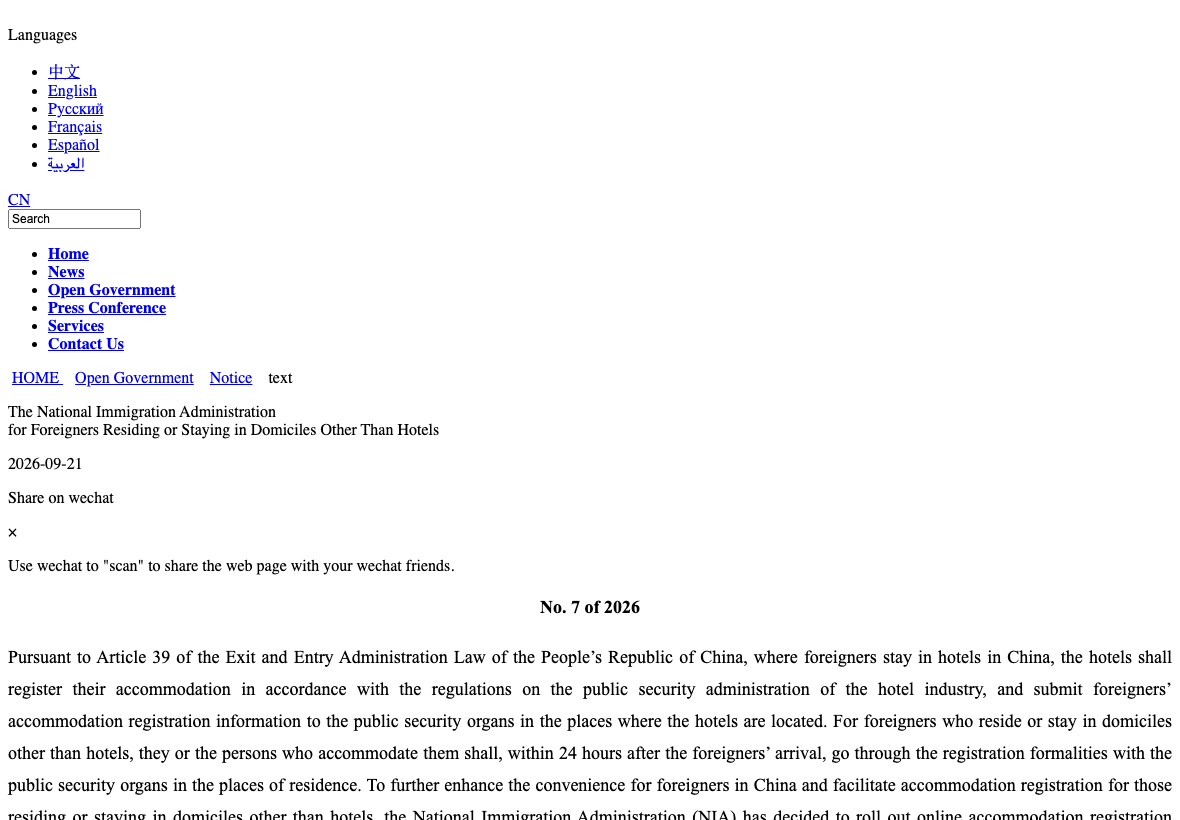
Original public NIA announcement, dated September 21, 2026. This screenshot shows the policy notice, not a completed registration or signed-in account. Read the official notice.
What changed on September 21, 2026?
On March 20, 2026, the NIA first introduced online non-hotel accommodation registration in seven provincial-level regions: Hebei, Liaoning, Zhejiang, Hubei, Guangxi, Chongqing and Sichuan. On September 21, 2026, NIA Announcement No. 7 of 2026 extended online registration nationwide. The obligation to register non-hotel accommodation within 24 hours did not disappear; the practical change is that qualified foreigners and hosts can use a central online service instead of relying solely on in-person registration.
This is relevant if your trip combines hotels with stays in a private residence. Do not copy older instructions that say online filing is available in only seven regions. The national NIA site is authoritative for this service, and local officers can advise on a specific address.
Step 1: Decide who should submit your first registration
Before your arrival, tell the host or accommodation provider that the address must be registered for your foreign stay. For your first registration in someone else's home, the detailed NIA guidance says the accommodation host should handle it. NIA's English explanation similarly recommends initial filing with host assistance because the host knows the property details. A host can be a Chinese or foreign national; it is the person providing the accommodation, not necessarily the passport holder.
Prepare the accurate address in Chinese and ensure you can reach the host when completing the registration. Have the foreign visitor's passport and travel details available as requested by the official form. The exact list of inputs, evidence images, identity checks and screen labels can vary by the person's situation; follow the current NIA on-screen instructions rather than copying unverified checklists from third-party websites.
For independent filing, the NIA specifically describes qualifying cases such as a self-owned residence or a subsequent registration at a residence already registered through the NIA service platform. If your case does not fit, arrange host assistance or obtain local public-security guidance. NIA who-may-register guide.
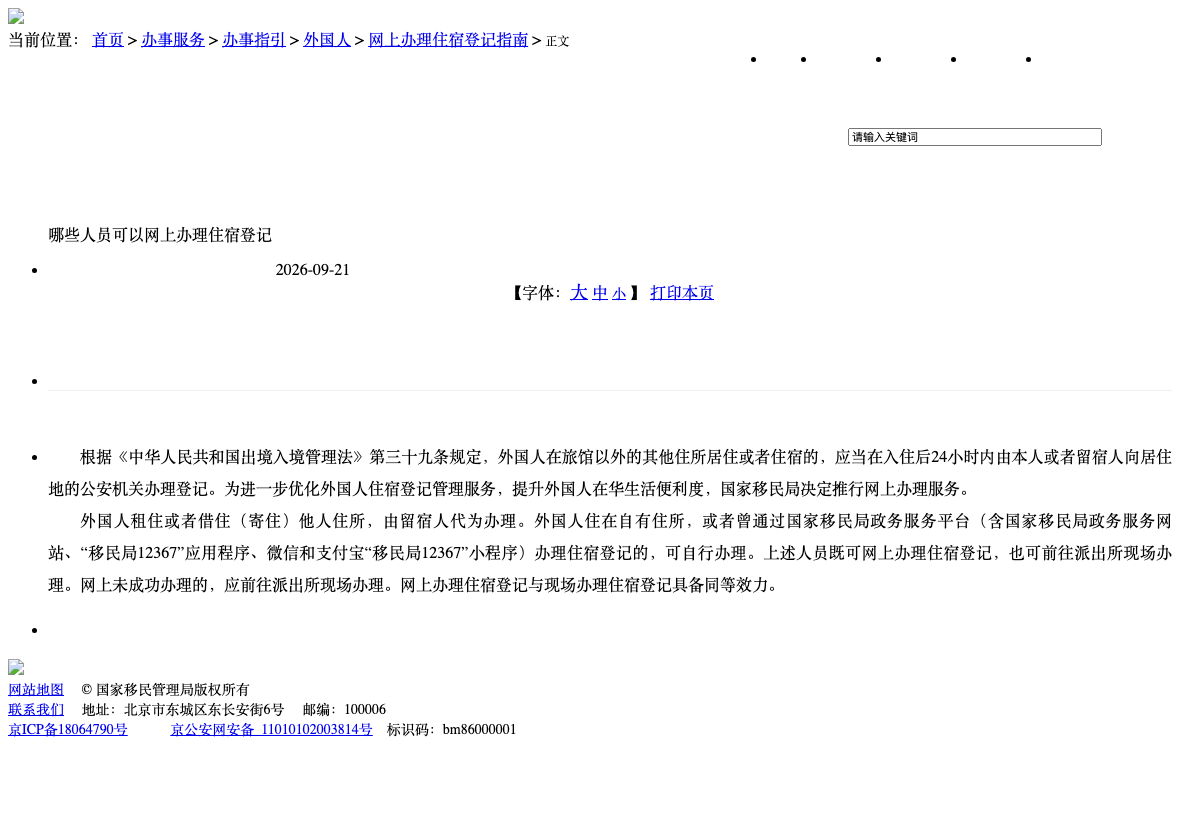
The NIA's updated host-versus-visitor guidance, dated September 21, 2026. It is a public government notice, not a live form. Open the original Chinese instructions.
Step 2: Choose an official online channel
You do not have to depend on WeChat. The NIA lists these channels:
- Website: open s.nia.gov.cn, the national government service platform.
- Phone app: use the official NIA 12367 (移民局12367) application.
- WeChat: locate the official NIA 12367 mini-program.
- Alipay: locate the official NIA 12367 mini-program.
The government maintains an official online-channel page with app and mini-program codes. You can use this instead of scanning an unknown QR code circulating in travel groups.
Registration and identity verification on the official platform come before the accommodation form. In the government service interface, look for Foreigner Service → Accommodation Registration (外国人服务 → 住宿登记). Actual language settings and menu positions may vary by device or version; use the current official guidance if a menu has changed. NIA policy explanation.
Step 3: Enter the host and accommodation details
The host or eligible foreign applicant follows the step-by-step instructions in the Accommodation Registration module. Enter the real residence and the actual person staying there. Do not enter a different address just because an online location picker is easier to use. The relevant local public-security agency is determined by where you actually stay.
Before you submit, check:
- The foreign visitor's travel document and identity information match what the form shows.
- The home address, district and any housing details match the actual stay.
- The host's information is correct where a host is responsible for the filing.
- The arrival information and the category of accommodation reflect your stay.
These are practical verification checks, not a fixed list of mandatory form fields. The NIA's screens determine which information must be supplied. Do not upload passports or residence documents to unrelated third-party “registration services” claiming to be the government.
Step 4: Find and keep the electronic registration record
Do not treat an upload or a green button as proof that the registration has been accepted. The NIA's English instructions point users to Registration Record Inquiry after submitting the application. Open the result, verify that the guest and property are correct, and keep the official electronic record available for later use. If the status is ambiguous or no record can be found, contact 12367 or the local police office rather than asserting that filing succeeded.
The September 21 NIA instructions explicitly say that applicants who have successfully registered online do not need to print the electronic record. Where registration proof is requested for relevant visa-document procedures or checks, the electronic record can be shown instead of the paper accommodation registration form. A paper copy, when necessary, can be obtained at the police station shown in the electronic record. NIA September 21 record guidance.
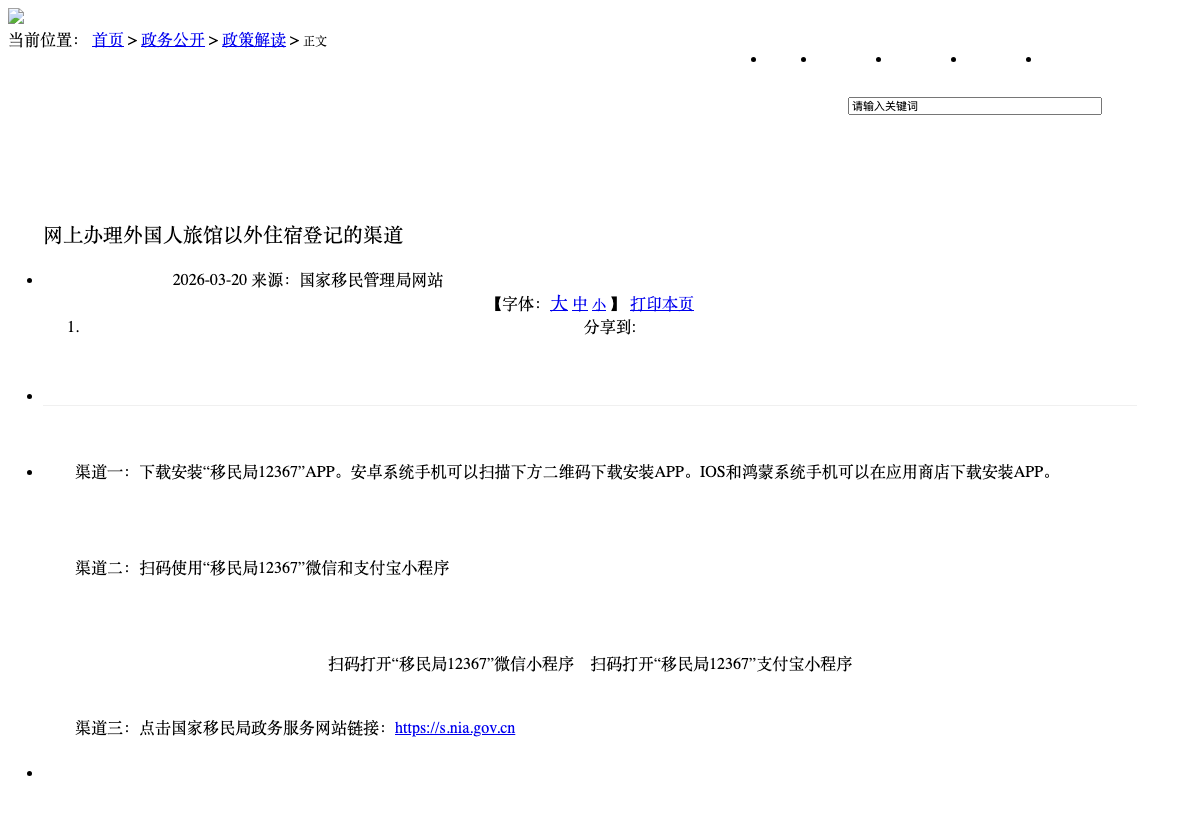
NIA's public online-channel guidance, originally published March 20, 2026. This locally rendered government page lists authentic service-entry options; the nationwide rollout followed on September 21. It does not depict a logged-in account. Original channel list.
What if the online registration does not work?
If the mini-program cannot load, identity verification fails or the accommodation submission never produces a verifiable record, avoid repeatedly submitting different property addresses. The NIA states that the in-person route remains valid. Ask your host to contact the responsible local police station (派出所) or visit the applicable public-security exit-entry service window for help.
For procedural questions, call the NIA 12367 service hotline and use the official NIA lodging-registration help index. The nationwide online service does not remove the responsibility to register correctly within the specified time. If you are near the deadline and cannot finish online, seek a local official fallback promptly.
The NIA also explains that failure to complete required registration can lead to a warning and potentially a fine under Article 76. This guide does not offer an exact fine amount, since the applicable facts and decision are for the authorities. NIA policy explanation.
If you move to another home, do you register again?
Do not assume one filing at one address automatically covers subsequent non-hotel stays elsewhere. Your obligation is tied to the accommodation where you actually stay. For a different address, ask the next host to handle the appropriate new registration. There are narrow exceptions in the national guidance for qualifying returns to a self-owned or habitual residence by certain permit holders; an ordinary short-stay guest should not assume those exceptions apply.
The NIA also publishes guidance on how to view and reuse prior accommodation records. Check that procedure before repeating an already-completed submission at the same qualifying address.
FAQ
Can I stay at a friend's house in China instead of a hotel?
Yes, subject to the applicable accommodation rules, but a non-hotel stay must be registered as required. For a first hosted stay, arrange for the host to assist with or complete the initial registration.
Is online foreigner accommodation registration available across China now?
Yes. The national rollout took effect on September 21, 2026. Earlier articles describing only the seven-region pilot refer to the March 2026 rollout stage. NIA No. 7 of 2026.
Do I need a Chinese phone number or WeChat?
NIA lists a website, its official app, and both WeChat and Alipay mini-programs, so WeChat is not the only entry route. Whether your chosen account-creation method can verify your own international number depends on the current service interface. See Do You Need a Chinese Phone Number? for the broader connectivity decision.
Does my hotel have to register me?
The national notice says hotels must handle guest registration and report accommodation information. For a hotel booking, give the front desk the required travel document and confirm that check-in is complete.
Can a foreign visitor register themselves when staying with family?
The NIA's detailed guidance distinguishes first stays in another person's home, for which the host handles the initial online registration, from qualifying cases where the foreigner can independently register, such as certain repeat filings or their self-owned home. Check the actual registration category rather than presuming you can always self-register.
Does an online registration record need to be printed?
No. Under the NIA's September 21 guidance, electronic records can be used for relevant document procedures and checks, and printing is not required simply because the registration was done online. Paper records remain obtainable through the relevant police station when necessary.
Does the new nationwide online service also change Chinese visa rules?
No. Accommodation reporting and permission to enter or remain in China are separate decisions. Check your passport and trip under CTD's visa checker.
Related CTD planning guides
- Where to Stay in Beijing — choosing a hotel base is separate from non-hotel registration.
- Do You Need a Chinese Phone Number? — arrange connectivity if the verification interface creates an SMS problem.
- China eSIM options — get online after arrival without confusing data-only plans with local SMS service.
- China Visa Checker — entry eligibility is not determined by accommodation registration.
- China Itinerary Review — review the timing and connections of your proposed trip, not an official registration service.
Official sources and review notes
Research verified October 11, 2026. Scope: non-hotel accommodation registration for foreign visitors in mainland China. This article distinguishes official policy from editorial checklists and does not claim to have logged into the NIA service or successfully registered an actual guest. The exact live account verification fields, document uploads and completion status must be checked in the authentic government interface.