Quick answer: Most short-stay visitors do not automatically need a mainland Chinese (+86) phone number just to enter China, pay with a linked overseas bank card, book a train, or request a DiDi ride. Several official visitor instructions explicitly accept international numbers. A +86 SIM becomes useful if a specific business, Wi-Fi login, delivery service, or local app insists on domestic SMS. Mobile data and a Chinese phone number are not the same product. Check the actual tasks on your itinerary before paying for another SIM. China government overseas visitor guide · Travel China SIM guide, March 2026.
Key takeaways
- Mobile internet only: an overseas roaming plan or compatible China travel eSIM may be enough; many travel eSIMs provide data only, not a +86 voice/SMS number.
- Alipay and Weixin Pay: China's official visitor guide says overseas or Chinese mobile numbers can be used for registration according to app prompts. It does not guarantee every identity, merchant or wallet function.
- DiDi: the government states that the DiDi Greater China app can register foreign phone numbers and international bank cards. An occasional driver may still need a way to contact you at pickup.
- 12306: foreign travelers can use the official 12306 English website/app and verify a passport; a mainland number is not stated as a universal condition for all verified buyers.
- Some local services: Chinese SMS-only Wi-Fi verification, delivery, local loyalty programs and older forms may ask for a domestic number. Treat these as app-specific obstacles, not entry requirements.
- Getting a mainland SIM: the Chinese telecom authority confirms foreigners can apply in person at an operator-run store with a passport or permanent residence ID; a local passport-holder cannot send an agent to register the card for them.
Decision table: do you really need a +86 number?
| Your task | Is +86 always required? | Better first action |
|---|---|---|
| Enter mainland China, stay in a hotel | No blanket +86 requirement in cited visitor procedures | Prepare your passport and arrival/accommodation details |
| Use mobile maps and translation | No if working roaming/eSIM data is available | Choose reliable data and download essential apps before travel |
| Register Alipay or Weixin Pay | No universal +86 requirement; overseas numbers described in government guide | Try supported international-number registration and issuer card linking |
| Book DiDi | Not universally; international number supported in official guide | Test sign-up and card payment before airport pickup |
| Buy a train ticket using 12306 | Not a universal rule for every foreign-passport booking | Verify passport identity in 12306 or at a railway ticket counter |
| Join public Wi-Fi that asks for SMS | Sometimes; provider-specific foreign-SIM support differs | Use cellular data or ask staff for a separate authentication option |
| Food delivery, local services, courier calls | May be useful or required by specific products | Check the exact app's login and delivery contact rules |
| Receive overseas bank one-time passcodes | A +86 number is not a substitute for your home number | Keep your original SIM active for essential messages |
The important distinction is between what the government explicitly supports and what an individual platform's latest screen allows. See the official national visitor guide and the 2026 tourist SIM guidance.
A local SIM, travel eSIM, and roaming are three different choices
Home-carrier roaming keeps your original number and may continue delivering your bank and account-security texts, subject to your carrier's roaming plan. It is usually the least disruptive setup but costs can vary significantly.
Travel eSIM can be convenient for a short stay if your phone is eSIM-compatible and unlocked. Check whether it explicitly includes calls/SMS and a Chinese +86 number. Many international travel products are data-only, so installing one will not solve a website demanding a mainland SMS code. Follow CTD's China eSIM guide for connectivity and device choices.
Mainland China SIM is the route most likely to supply a local telephone number, voice service and text messages. It normally requires identity registration and a compatible device. The 2026 Chinese telecommunications-authority guideline says phones must support 5G or VoLTE as applicable and that foreigners can register with a valid passport or Foreign Permanent Resident ID at an operator's own service hall. Tianjin Communications Administration, April 2026.
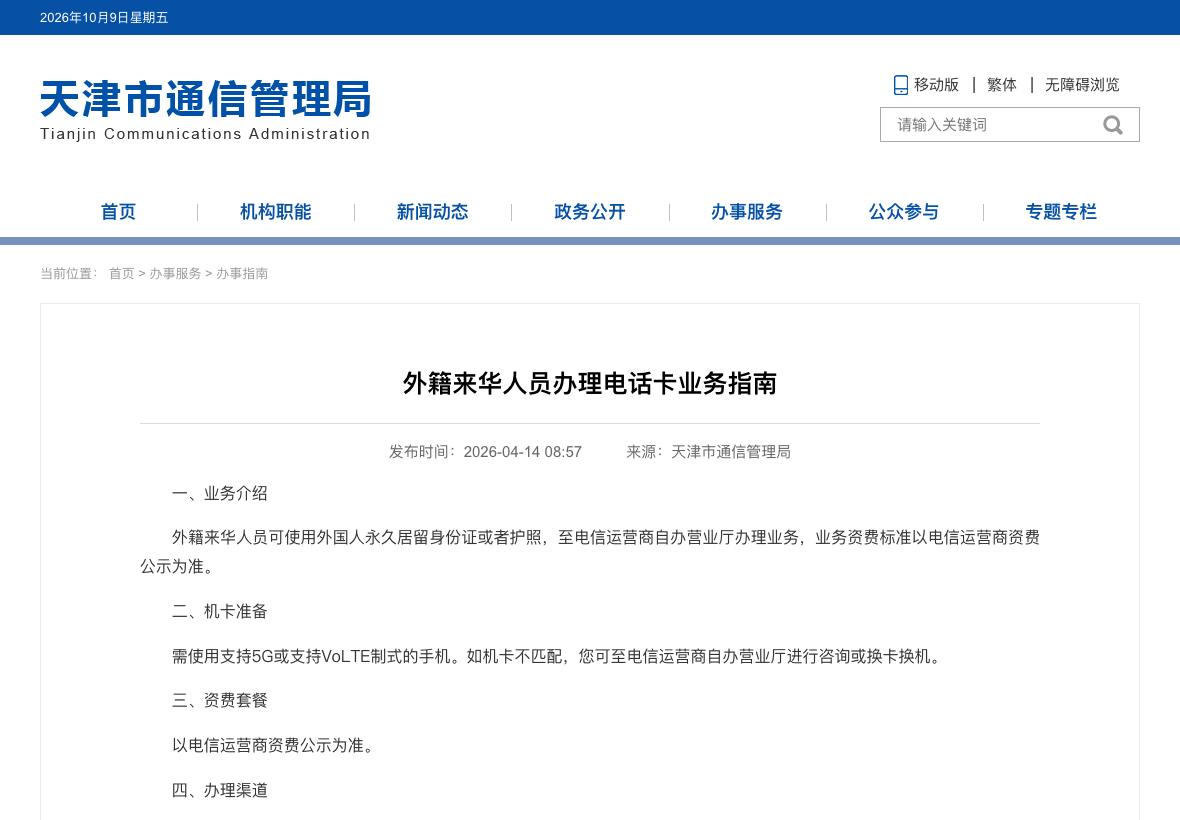
Official 2026 telecom guidance. Source screenshot is a public government webpage, not a live SIM-registration screen. Read the bilingual announcement.
Step 1: Test your three most important apps before flying
Start with one booking app, one payment app, and one transport fallback. First, confirm that your phone can receive an SMS or verification call on your home number while roaming. Next, try the supported international-number registration flow for Alipay or Weixin Pay, and check international-card authorization. Finally, try DiDi Greater China with your country code and card. The official visitor guide describes both foreign-number payment registration and foreign-number DiDi registration. Government visitor guide.
Minimum pre-departure app stack
Set up one primary route per essential task — not ten “must-have” apps
| Travel task | Prepare before flying | Independent fallback |
|---|---|---|
| Mobile data | Your chosen home-roaming or travel-eSIM plan, installed/activated according to its instructions | Hotel/airport Wi-Fi or an operator-run mainland SIM branch if the planned data route fails |
| Pay | Set up one supported payment wallet such as Alipay or Weixin Pay with the international-number/card flow that works for you | Eligible physical bank card plus modest RMB cash; do not make both backups depend on the same wallet account |
| Navigate | Install Amap Global or your chosen mainland-capable map and verify your hotel / first station / first attraction | Chinese names and addresses saved offline; see the map setup guide |
| Rail, if your itinerary uses trains | Set up the official 12306 English website/app path and complete passport verification before a time-sensitive booking | Staffed railway ticket office with the passport used for travel |
| Ride hailing | Test DiDi Greater China with your foreign number, or the ride-hailing entry inside a payment app you already use | Licensed taxi rank / staffed airport transport route; keep the destination in Chinese |
| Reach a hotel/tour/provider | Keep the booking-platform messaging route and any provider contact the reservation actually uses | Email, official phone number or front desk; do not install WeChat solely because an unrelated list calls it “mandatory” |
Departure test: for every row you actually need, open the app/service, finish sign-in or identity verification where possible, confirm the home number can still receive critical account messages, and save one offline fallback. An app is “essential” only if it serves a task on your itinerary.
If a particular app refuses the foreign country code, record the exact app and step. A failed feature does not demonstrate that the entire country requires domestic mobile service. Before purchasing another SIM, ask whether the same task can be completed at a staffed counter or using another supported application.
When English is not available: use a three-layer communication fallback
| Layer | Use it for | Prepare |
|---|---|---|
| 1. Screen / camera translation | Menus, signs, short staff messages and ordinary questions | Shanghai's current official WeChat guide documents long-press message translation and + → Scan → Translate for photographed Chinese text. Test the feature you plan to rely on before travel. |
| 2. Saved Chinese text | Hotel address, station, attraction entrance, allergy statement, delivery point | Keep the exact Chinese name/address in offline notes or screenshots. Showing verified text is often more reliable than trying to pronounce an English place name. |
| 3. Staffed / public-service escalation | A problem that cannot be solved by showing or translating one sentence | Use the service channel for the exact city/provider. For example, Beijing's 12345 system currently provides multilingual help for public-service questions and explicitly describes foreign-language support; do not assume identical language coverage for every city's hotline. |
Do not put passport numbers, bank-card details or account passwords into a random translation service. For identity, payment or medical issues, translate only the minimum text needed and use the official provider's support channel for sensitive records.
我不会说中文,可以打字给我看吗?
I don't speak Chinese. Could you type it so I can translate it?请看这个中文地址。
Please look at this Chinese address.
For maps and verified Chinese POIs, use the place-list workflow. For restaurant-specific translation and dietary constraints, use the Chinese-menu workflow rather than treating a translated dish name as an allergy guarantee.
Step 2: Decide whether you need mainland SMS, not just data
Ask these specific questions:
- Does a service explicitly send a code to +86 only? That is a local SMS requirement.
- Does someone physically need to call your number? A voice line can help with hotel deliveries or car pickup, but official ride-hailing methods also provide an in-app booking route.
- Do you just need internet? A travel eSIM or roaming data can handle maps, translation, support chat and QR payments once your accounts work.
- Will your bank send verification to your home number? Retain your home SIM or another authorized way to receive OTPs, rather than replacing it too early.
The 2026 Travel China SIM and Network guide specifically notes that some public Wi-Fi services authenticate using a domestic SMS code; that is a reason to arrange alternative data, not proof that all visitors must obtain a mainland telephone number.
App says “+86 only”: do not buy a SIM until you identify the blocked task
A +86-only field proves that that screen or service expects a mainland number. It does not prove that the underlying travel task requires one. China’s national visitor guide explicitly says payment apps can register foreign or Chinese mobile numbers, and that DiDi Greater China supports foreign mobile numbers. Shanghai’s current payment guidance also says an e-CNY wallet can be opened with an overseas mobile number. National visitor guide · Shanghai payment guidance.
| What is blocked? | Try before buying +86 | When a mainland SIM becomes justified |
|---|---|---|
| Alipay / Weixin Pay registration | Use the official international-number registration route and check the country code and current app prompts. | Do not buy +86 solely for this if the supported overseas-number flow works. |
| Ride hailing | Try DiDi Greater China with the foreign number, Alipay Taxi, WeChat ride-hailing, Trip.com transfer or a licensed taxi. | Only if the exact ride/service you need genuinely requires domestic SMS or local calling. |
| Local delivery / loyalty / Wi-Fi service | Check whether the merchant can take the order at the counter, through another mini-program, hotel desk, or a supported international service. | If the service is important to your trip and every supported route for that exact service requires +86. |
| Bank verification | Keep your original SIM active and use your bank-approved OTP method. | A +86 SIM usually does not solve OTPs sent to your existing overseas bank number. |
| Account-security or friend-verification block | Use the platform’s official recovery/support route. | Do not assume a new number removes an account-security review. |
- Name the exact app and step. “China needs +86” is too broad; record which screen rejects your country code.
- Separate the task from the app. If the goal is to pay, ride, order food or reach a hotel, check whether another official route completes the same task.
- Do not use fake, rented or borrowed SMS numbers for payment or identity accounts. They can create recovery and ownership problems later.
- Buy a local SIM only for a verified domestic-SMS need. If you reach that point, follow the foreign-passport China SIM guide.
If the problem is specifically WeChat friend/security verification, use the WeChat verification recovery guide. If you only need data, compare eSIM and roaming instead of buying the wrong product.
Step 3: How to obtain a local SIM with a foreign passport
If you decide you need +86 voice/SMS, the most reliable official path is:
- Take your original valid passport (or eligible permanent residence ID) and your phone to an operator-run China Mobile, China Unicom or China Telecom service hall.
- Check your device compatibility. The communications regulator's 2026 guide calls out 5G/VoLTE and advises consulting the operator when device/SIM compatibility is uncertain.
- Ask for the price and included services in writing: number validity, included data, voice/SMS, domestic calls, hotspot, payment methods, expiration/renewal and account closure.
- Complete the official in-person identity registration and verify that you can place/receive a call and receive an SMS before leaving.
- Keep account receipts and ask how to terminate the plan at departure if you do not need ongoing service.
The operator hotlines published by the telecom regulator are 10000 (China Telecom), 10086 (China Mobile) and 10010 (China Unicom); staff can direct you to an operator-run location. The same authority explicitly says another person cannot apply on your behalf using your identity documents. Official bilingual SIM guide.
What if your foreign number does not receive a verification code?
First, verify the country-code format, any blocked international-SMS setting and whether your home carrier actually supports SMS while abroad. If other texts arrive but only one application fails, the issue may be that application's delivery or country support. Contact the platform instead of retrying endlessly or borrowing another person's identity.
If this happens after landing and you urgently need a ride, use the government-listed alternatives: the Alipay Transport → Taxi entry, a supported WeChat ride-hailing entry, a licensed taxi rank, or a prebooked airport shuttle. See DiDi with a foreign phone number. Booking options and exact app labels can change, so follow the current interface.
If your bank verification texts are the issue, a new Chinese SIM may not receive codes sent to your existing home-bank number. Keep a secure bank-approved verification method before travel.
When is a Chinese phone number worth buying?
It becomes worthwhile when you are staying longer, making frequent local deliveries, registering multiple local-only services, or encountering a specific verified +86-only bottleneck. For a short city trip focused on transport, hotels, cards and attractions, start with working data plus your original phone number and buy a local SIM only if a real task demands it.
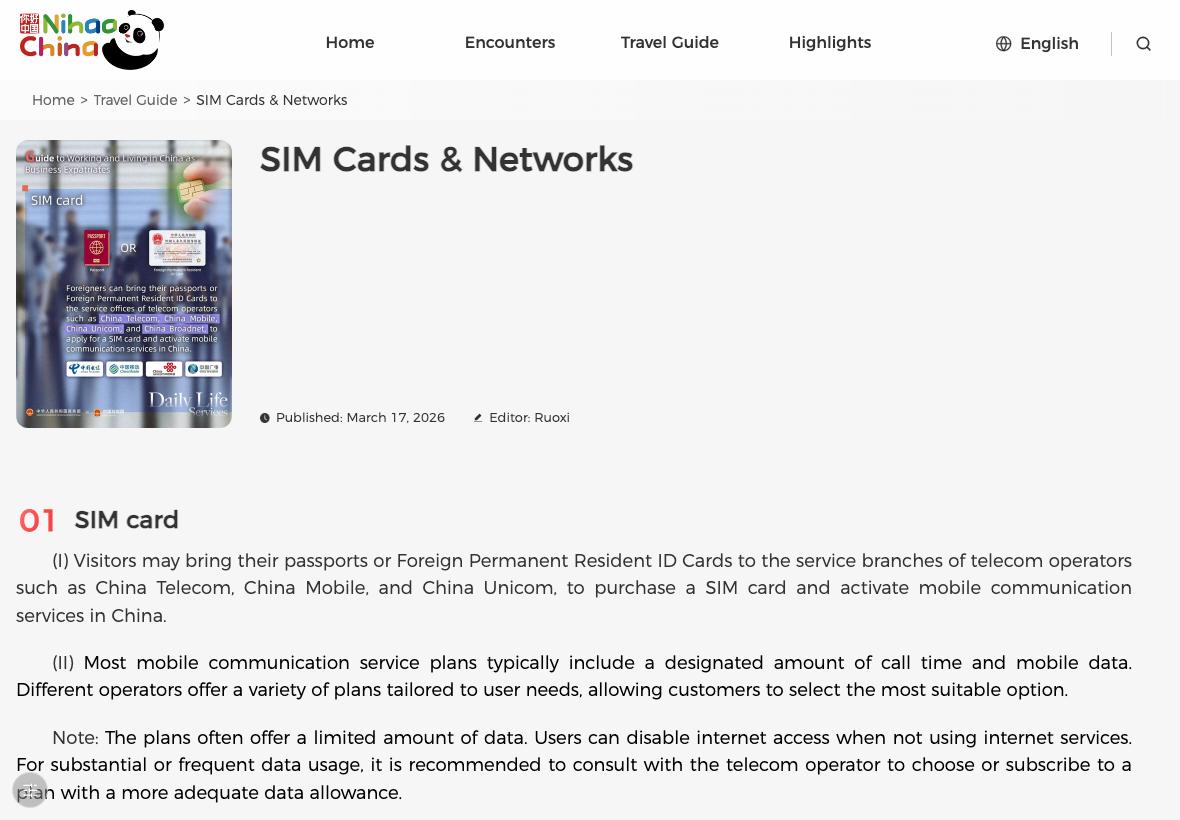
Public tourism service guide, last checked October 9, 2026. Official Travel China SIM comparison.
FAQ
Do I need a +86 number for Alipay?
No universal requirement is stated in the official visitor guide: foreign mobile numbers are supported for payment-app registration according to the current app prompts. Account-specific checks may still apply. If passport verification or payments fail, use CTD's Alipay verification troubleshooting guide.
Does a China eSIM give me a Chinese phone number?
Not necessarily. Many short-stay travel eSIMs are data-only, and a local operator eSIM product has its own device/activation rules. Check the plan details before paying.
Do I need a China phone number to use DiDi?
Government instructions explicitly describe international phone number and international credit-card support in the DiDi Greater China app. Use the correct region/country code and check payment compatibility. DiDi guide.
Can I buy a local SIM without my passport?
For foreign nationals, the regulator specifies original valid identity documents and in-person operator registration. Do not assume a hotel, online shop or unrelated agent can register a card legally for you.
Will a local SIM make blocked overseas websites available?
Phone numbers, network routing and international website availability are separate issues. A domestic SIM provides connectivity but does not establish access to every overseas internet service.
Sources and scope
Last checked October 18, 2026. This article covers temporary foreign visitors to mainland China, not residents seeking long-term postpaid plans. Operator prices, eSIM device compatibility and individual app country-code support must be checked at purchase.