Quick answer: If airline check-in staff say you need a China visa even though you planned to use 240-hour visa-free transit, do not argue only from the phrase “240 hours.” First confirm that your passport nationality, exact entry port, onward third-country/region route, confirmed departure and planned stay match China's current rules. Then show the official National Immigration Administration (NIA) policy and your real onward ticket, and ask the airline to have a supervisor or travel-document specialist check the transit conditions. An airline may still refuse carriage, and the Chinese border authority decides whether to grant temporary entry. NIA policy, updated August 20, 2026.
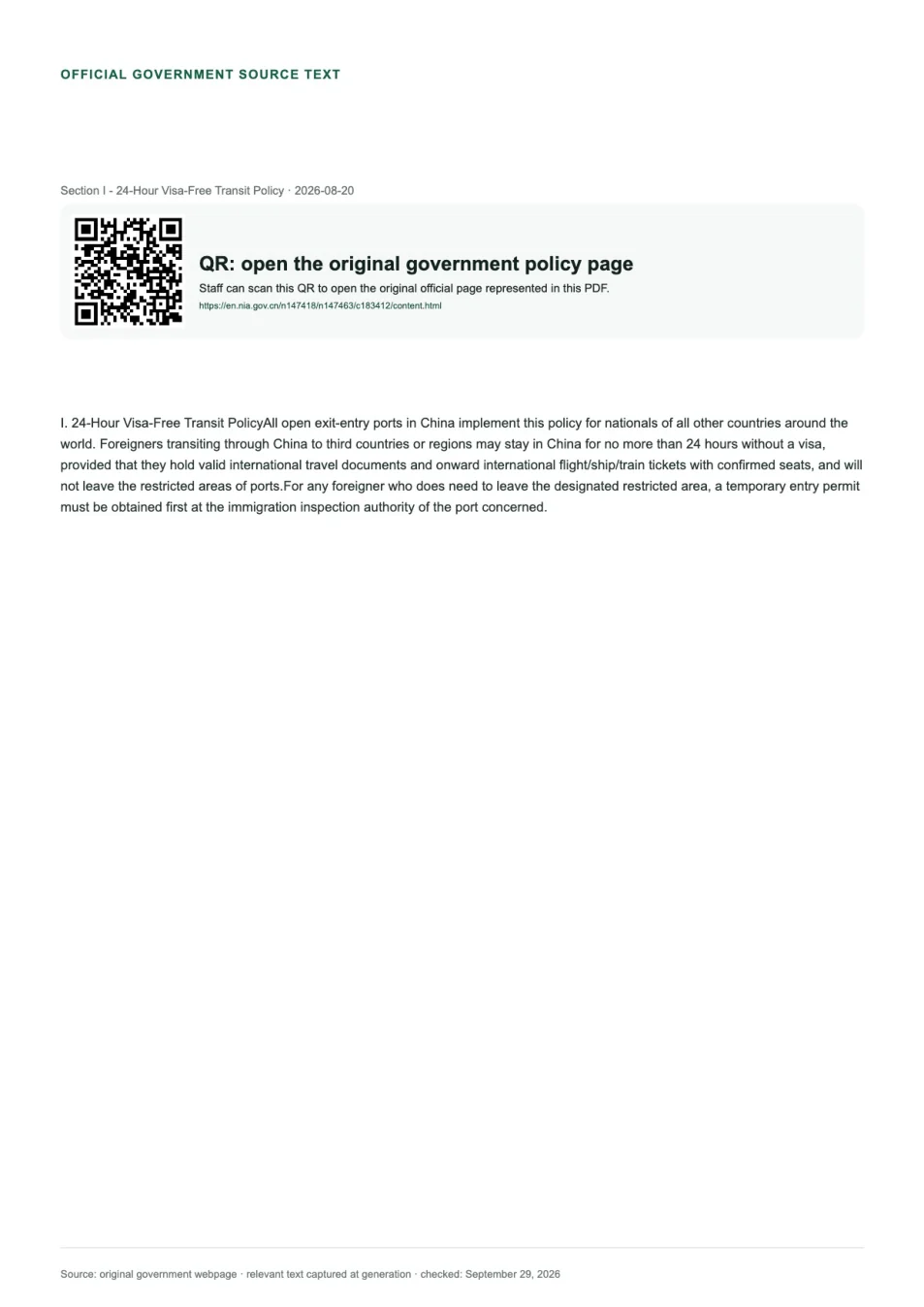
Illustrative CTD proof-kit preview. It is not an issued visa, an airline authorization, or a guaranteed boarding pass. Carry the actual NIA page and your own confirmed booking.
Before escalating, check the actual eligibility rule
China's current NIA guidance says the 240-hour program covers 57 eligible nationalities, entry through 65 designated ports in 24 provincial-level regions, and a qualifying transit onward to a third country or region with confirmed travel. The policy also limits where you may stay and which activities are permitted. Not every international arrival is automatically eligible. Current NIA policy.
| What the agent questions | Document to show | What to re-check yourself |
|---|---|---|
| “Visa required for China” | Current NIA 240-hour policy (English and, if needed, Chinese) | Are you one of the covered passport nationalities? |
| “This is a trip to China, not transit” | Inbound itinerary A → mainland China → B and onward confirmation | Is B genuinely a different country or region from A? |
| “Your connection/entry port is not permitted” | Arrival/departure itinerary and official port rules | Is the actual arrival port eligible for this program? |
| “You may not stay that long” | Ticket showing confirmed onward date/time | Does the travel remain inside the 240-hour limit and permitted area? |
| “We cannot see your onward flight” | Airline e-ticket confirmation with reservation status | Is the departure confirmed, rather than a vague unbooked plan? |
Use the CTD China Transit Visa Checker to evaluate the main route categories. For a print-ready proof checklist, see China onward ticket proof at check-in. These aids organize evidence but do not determine entry.
What to do at the airline check-in counter
- Stay with the actual route facts. Give the officer the passport nationality, inbound flight, China arrival airport/port, onward destination and confirmed departure date.
- Show the current official NIA policy, not an old 72/144-hour article or a social-media screenshot. As of August 20, 2026 the NIA lists 57 countries and 65 ports; older summaries can be outdated.
- Show your own onward travel confirmation. It should identify a confirmed booking and departure that fits the transit rule. A one-way flight into China alone does not establish this eligibility.
- Ask for a supervisor or document-check specialist. Request that they review the exact transit exception and route, rather than merely asking whether a normal tourist visa is required.
- Ask what specific condition is missing. A wrong port, incomplete booking or non-eligible nationality cannot be repaired with a printed policy quotation.
Beijing's official 240-hour guidance includes informing the airline about the planned transit in its journey procedure. This is a practical preparation step, not an order that forces an airline to issue a boarding pass.
Show the desk this Chinese and English explanation
我准备按中国240小时过境免签政策过境,这里是中国官方规定、护照和已确认的第三国(地区)离境机票。能否请主管复核适用条件?
I plan to transit under China's 240-hour visa-free transit policy. Here are the official rule, my passport and my confirmed onward ticket to a third country or region. Could a supervisor review the eligibility conditions?
If the agent disagrees, politely ask: “Could your travel-document or international policy desk verify this specific China transit exemption and itinerary?” Their internal process may differ by airline. Do not claim that every reservation system shows the same message or that a single database necessarily caused the refusal.
If the airline still refuses boarding
Request the specific reason, ideally in writing or attached to your booking. Save your itinerary, the names of the route and flight legs, any relevant airline messages, and the time you contacted support. Ask the carrier what review, rebooking or refund options its rules allow. If your travel is time-critical, consider an alternate route or obtaining the necessary visa for a later trip rather than improvising unconfirmed onward tickets.
Documented traveler discussions show that some check-in counters question transit eligibility, while others accept confirmed onward proof after discussion. These are case reports, not evidence of a measured rate of airline refusals or proof that escalation will always succeed. FlyerTalk traveler reports.
Do not mix up 24-hour airside transit and 240-hour temporary entry
The NIA's 24-hour direct airside transit and 240-hour transit allowing temporary entry have different conditions. A plan to leave the airport, collect bags and visit the city needs the appropriate entry arrangement; the 24-hour airside rule alone does not automatically authorize sightseeing. For a Beijing route, see 240-hour transit through Beijing. For a normal visit or another nationality, see Do I need a visa for China?.
FAQ
Can I board with two separate airline tickets?
Separate tickets are not automatically proof of ineligibility under every circumstance. What matters for the rule is whether the traveler can show a confirmed qualifying onward journey and meet the actual policy conditions. Carriers may have separate through-ticket, baggage and transfer requirements.
Is Hong Kong or Macao considered a third region?
Mainland China and Hong Kong/Macao are treated differently for relevant route analyses, but the exact A → mainland → B sequence must still satisfy the official onward-destination conditions. Do not assume “return to where I started” qualifies.
The website says I qualify. Can the airline still say no?
Yes. A third-party checker is advisory. The airline makes its carriage/document decision, while Chinese immigration officers decide temporary entry under the actual policy.
Should I pay for a fake onward ticket reservation?
No. Use genuine confirmed travel documents. If the booked route does not fit the rule, change the travel plan or get the proper visa instead.
Official sources and onward actions
- National Immigration Administration, 240-hour policy updated August 20, 2026
- National Immigration Administration, Chinese transit rule
- Beijing government, 240-hour transit check-in process
- CTD: onward-ticket evidence and airline-counter proof pack
- CTD: China Transit Visa Checker
Reviewed October 11, 2026. An official document helps an agent verify the rule; it does not guarantee boarding or immigration admission.