Entry & Visa / Entry & Visa / SOLVE A SPECIFIC PROBLEM
Does Hong Kong or Macau Count as a Third Region for China’s 240-Hour Transit?
The decisive route comparison is not the country where your vacation starts or eventually ends. It is the country or region immediately before entering mainland China, and the first one after leaving it.
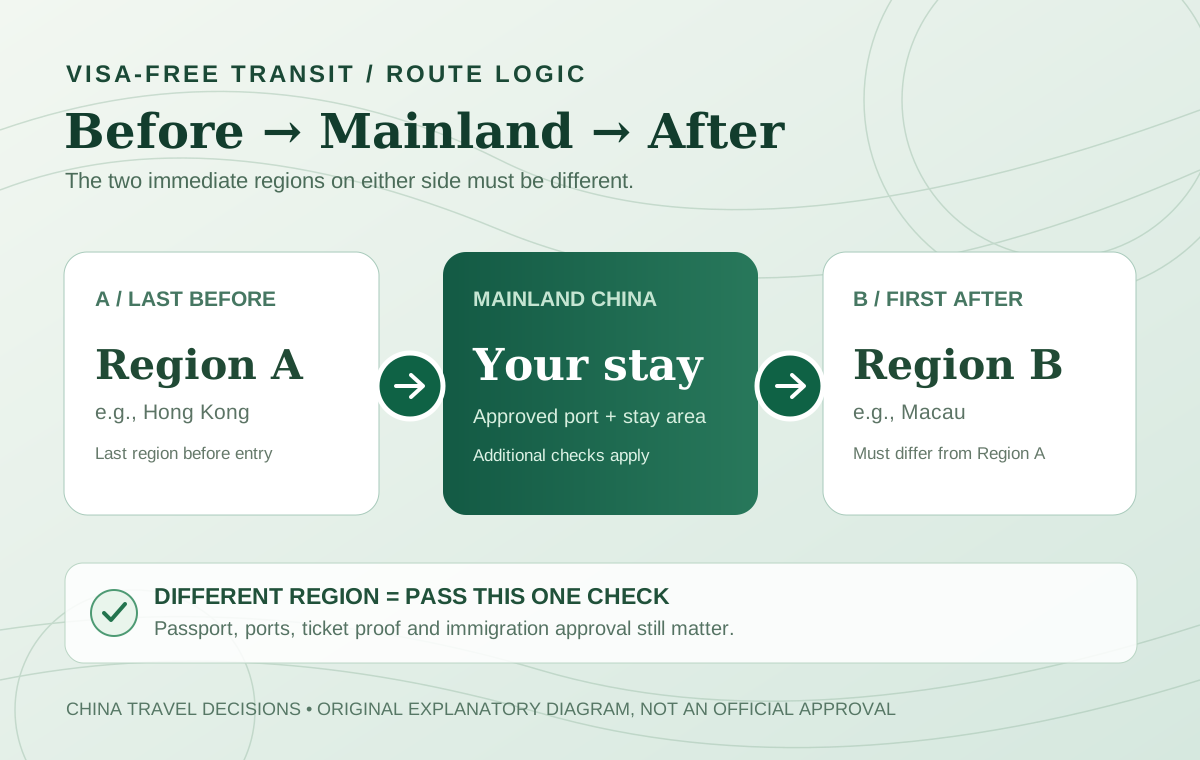
Yes, Hong Kong and Macau can be third regions — but direction matters.
China’s National Immigration Administration describes the 240-hour visa-free transit route as travel through mainland China to a different third country or region. The official Hong Kong high-speed rail guide expressly lists Hong Kong, Macao and Taiwan as qualifying onward regions. That does not itself establish the traveler’s passport, port, time, or onward-ticket eligibility.
Beijing’s official inbound-travel FAQ supplies a particularly useful way to test a multi-leg itinerary: the last country or region immediately before mainland China must be different from the first country or region immediately afterward. A prior stop several flights away does not replace the last international departure point for this comparison.
As of the NIA update on 20 August 2026, the 240-hour scheme covers nationals of 57 countries using 65 designated ports and permitted stay areas. You must still hold the required passport and confirmed onward travel within the permitted period. Immigration decides at the port.
“HK is a third region” does not mean HK → mainland China → HK qualifies. Nor does a different ultimate home country rescue a route whose immediate inbound and outbound regions are the same. Use the full transit checker before relying on one route example.
Compare your last inbound and first outbound regions
Select the route shape that is closest to your confirmed itinerary. These examples test only the third-region dimension, not the full policy.
The immediate regions differ
HK and Macau are different regions for the route comparison, so this example passes that one dimension. Now check passport nationality, eligible entry/exit ports, permitted areas, stay time and confirmed tickets. A route diagram never issues transit permission.
Run the complete transit checker →This is a decision aid, not an official approval, a live bank diagnosis, or access to your personal booking/payment records.
What “third region” actually compares
Only the two immediate regions on either side of the mainland border are compared here. Other eligibility gates remain separate.
Your distant country of departure can be relevant to tickets, but does not override the last stop.
Identify the country/region your inbound journey leaves immediately before mainland China.
Enter only via an approved port; stay in the permitted area and within the approved period.
Must differ from the region immediately before mainland entry for this transit route test.
Six itinerary examples, each with a next action
These are route-shape illustrations for the third-region rule. “CHECK” is not immigration approval.
| Your situation | What it indicates | Next move |
|---|---|---|
| CHECKUnited States → Beijing → Japan | United States and Japan are different countries. | Check the passport nationality, Beijing port, ticket date/seat and permitted stay in the transit checker. |
| BLOCKEDUnited States → Beijing → United States | Return to the same country directly after mainland exit. | Investigate ordinary visa-free entry or the appropriate visa instead. |
| CHECKHong Kong → Shenzhen → Macau | Hong Kong and Macau are different regions. | Check which Shenzhen port and onward route actually qualify; provide confirmed onward tickets. |
| BLOCKEDHong Kong → Shenzhen → Hong Kong | The regional endpoints match. | Do not use this loop as a third-region transit plan; check other entry routes. |
| BLOCKEDGeneva → Paris → Beijing → Paris | France is immediately before and after mainland China. | See Beijing’s official FAQ; a more distant Swiss origin is not the route comparison. |
| CONDITIONALHong Kong → Shanghai → Tokyo → Hong Kong | First outbound region is Japan; a later Hong Kong return is a separate onward leg. | Verify confirmed first outbound segment, port/time rules, passport and ticket proof before relying on eligibility. |
How to validate the full route before booking
Do these checks in order; a seemingly valid A → mainland → B shape is only the start.
Write every confirmed travel segment
List the airport, city and country or region for the last stop before mainland entry and the first stop after mainland exit. Include layovers, train/ferry legs, and separate reservation numbers. Do not abbreviate a multi-leg journey into “US → China → US” if there is a different immediate region.
Confirm your nationality and ports
Use the current NIA list for eligible passports and its approved ports. The 2026 NIA update lists 57 nationalities and 65 eligible ports, not the older numbers still shown in some regional guides.
Open current NIA policy ↗Check stay dates and permitted areas
A stop lasting up to 240 hours is not permission to travel across all of China. Confirm your port pair, regional stay restrictions and any intercity movement plans with official guidance.
Check movement during transit ↗Make the onward ticket verifiable
Keep ticket or itinerary evidence with the first departure date, confirmed booking and onward destination. Contact the airline if the itinerary is split across bookings or involves different transport modes.
Open the evidence guide ↗Retain a non-transit fallback
If the route does not satisfy the third-region rule, do not try to argue it into compliance at the check-in desk. Check ordinary visa-free entry eligibility or apply for a visa as appropriate.
Check another entry basis ↗Copy your third-region route check
Complete these six lines before travel or discussing the route with a carrier.
Tick items as you confirm them. Nothing is sent to CTD or saved to a server.
Questions people ask at this stage
Is Hong Kong a separate country for China transit?
The relevant official terminology is “third country or region”, not an assertion that Hong Kong is a separate sovereign country. The HK high-speed rail operator expressly lists Hong Kong, Macao and Taiwan as eligible onward regions for the 240-hour rule. The actual route must still go to a region different from the one immediately before mainland entry.
Can I enter from Macau and leave for Hong Kong?
That is a different-region sequence for the third-region comparison. However you must verify the exact approved port, passport eligibility, confirmed tickets and regional stay rules. Do not infer universal eligibility from the route alone.
What if my original journey began in London but I connect through Paris?
For this route comparison, Beijing’s published example identifies the last region before mainland China, not the country at the beginning of a longer booking. If the last inbound region is France and first outbound region is France, it fails the third-region distinction.
Does my final return home matter?
Your complete trip matters operationally, but the key comparison here concerns the immediate regions around mainland China. A later flight back home does not automatically change the first destination after mainland exit.
Can I use the 240-hour rule twice?
Repeated entries require independent checking of each complete route and current rules. See CTD’s dedicated repeat-transit guide rather than assuming a valid first route makes the second one eligible.
Official sources and further checks
Policy/issuer sources are authoritative within their scope; examples in this guide are explanatory, never a guarantee.
Researched 16 October 2026. Rules, wallet screens, issuer decisions and port/airline practice can change. Check the source at the time you act.